Current Monitoring in California
California Surveillance of Wastewaters (Cal-SuWers) Network
In California, wastewater monitoring is carried out by several programs who voluntarily contribute their data to the California Surveillance of Wastewaters (Cal-SuWers) Network, which is managed by CDPH. These data are also submitted to the Centers for Disease Control and Prevention (CDC) National Wastewater Surveillance System (NWSS). The Cal-SuWers Network includes data collected and reported by:
CDPH California Surveillance of Wastewaters (Cal-SuWers) Program
And other contributing local county or city public health departments.
Altogether, the Cal-SuWers Network monitors wastewater in more than 85 sites in 36 counties, covering approximately 60% of California’s population. On average wastewater samples are collected two to three times per week and tested for infectious disease pathogens of public health importance. Common pathogens include SARS-CoV-2 (COVID-19), influenza, RSV, mpox, and norovirus, among others.
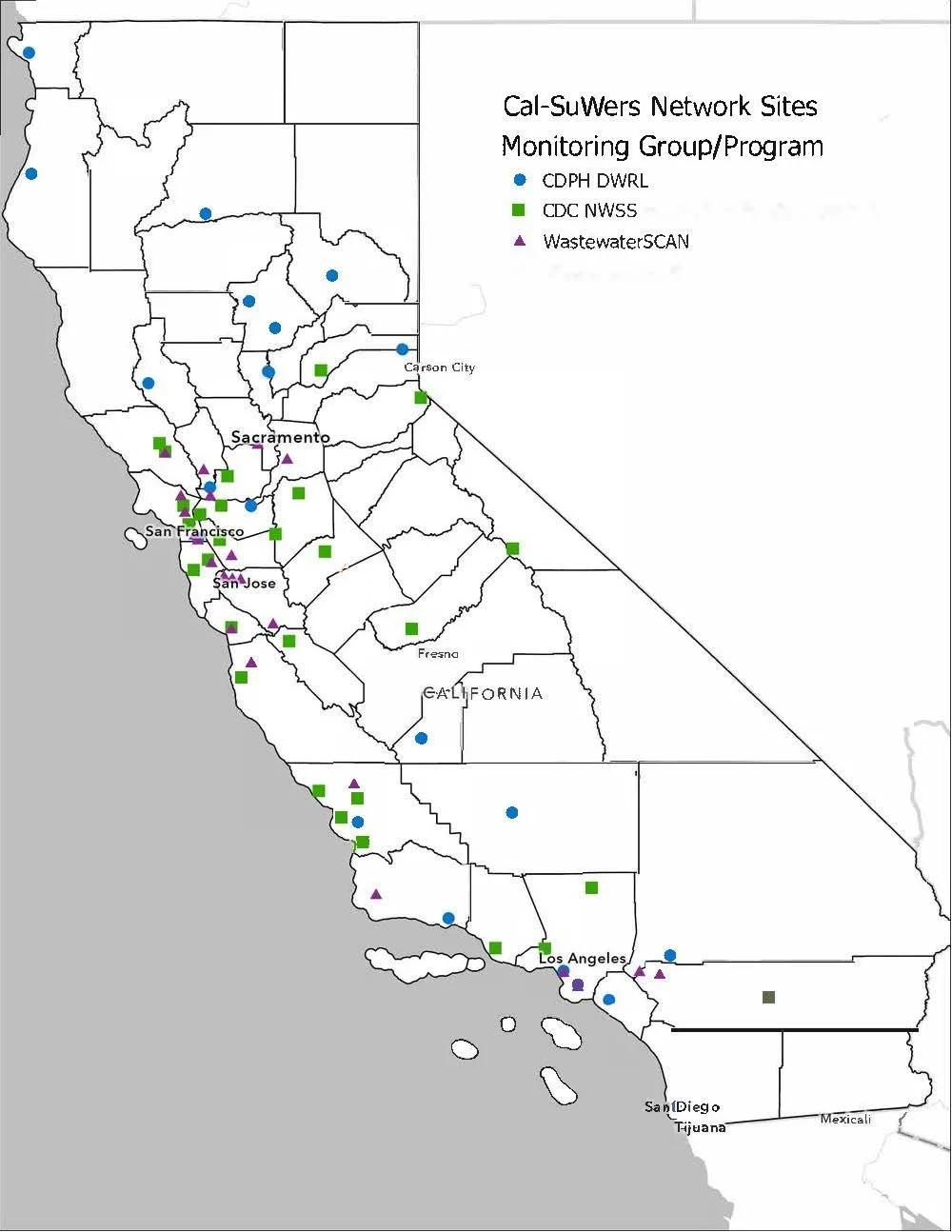
*Image last updated October 9, 2025
Visit the CDPH WWS Dashboard for more up-to-date site information
Pathogens Monitored
Wastewater surveillance can help track the presence and amount of different pathogens (germs, such as viruses, bacteria, and fungi) in communities across California. The specific pathogens tested for at each site may vary, depending on the monitoring program, and can change over time based on needs and resources.
Below is a list of pathogens that are monitored in wastewater in California through different
programs participating in the Cal-SuWers network.
*Pathogen list last updated October 8, 2025. Please visit each program’s webpage for additional up to date details about what is being monitored by that program.
-
SARS-CoV-2
RSV
Influenza A
Subtype H5
Mpox
Clade I (pan-Clade I assay)
Clade II
-
SARS-CoV-2
RSV
Influenza A
Subtypes:
H1
H3
H5
Influenza B
Mpox
Clade I (pan-Clade I assay)
Non-specific Orthopox Virus (NVO)
Measles - wildtype
-
SARS-Cov-2
RSV
Influenza A
Subtypes:
H1
H3
H5
Influenza B
Mpox
Clade Ib (Clade Ib assay)
Clade II (Clade II assay)
Measles - wildtype
Norovirus
Candida auris
EVD68
Human Metapnuemovirus
Hepatitis A
West Nile Virus
And others
For updates to the list of pathogens, visit WastewaterSCAN’s Pathogens webpage.
For more information about pathogens monitored see below.
Respiratory Viruses
-
COVID-19 is a disease caused by a virus called SARS-CoV-2. It affects the lungs and respiratory system and can feel like a cold, the flu, or even pneumonia. Most people who get COVID-19 have mild symptoms or sometimes none at all. But it can be very serious for older adults, people with weak immune systems, or those with other health problems. In some cases, it can lead to hospitalization or even death.
Symptoms usually show up 2 to 14 days after being exposed. A person can spread the virus before they feel sick or even if they don’t feel sick at all. COVID-19 spreads through the air when someone who is infected coughs, sneezes, breathes, or talks.
COVID-19 is still a big concern for public health because it can spread quickly and make many people sick at once, which can overwhelm hospitals. Vaccines are available and are the best way to protect yourself. They help your body build immunity and can prevent serious illness.
For more information about COVID-19, visit the CDPH COVID-19 webpage.
-
Flu is a common respiratory illness, caused by the influenza virus, and can result in mild to severe illness. Some people may be at higher risk for severe disease, including hospitalization and death.
Common symptoms of the flu include head and body aches, sore throat, fever, and respiratory symptoms like a cough. Flu can be spread when an infected individual coughs, sneezes or talks. Symptoms of flu may appear 1-4 days after exposure. The best way to protect yourself against flu is by getting vaccinated.
There are four types of influenza viruses; A, B, C and D. Influenza A and B are the ones that cause the “flu season” each year. In California, wastewater surveillance is used to track the following flu viruses and subtypes:
Influenza A (Subtypes H1, H3, and H5 [Bird Flu])
Influenza B
Bird flu, also known as avian influenza A (H5N1) or highly pathogenic avian influenza (HPAI), is caused by a subtype (H5N1) of the influenza virus. It can cause serious illness and death in birds and mammals. Human infections with bird flu viruses are rare, but they can happen when the virus gets into a person's eyes, nose, mouth, or when inhaled. Those at higher risk include people who work with or are around animals infected with bird flu or raw milk.
For more information about flu visit the CDPH Influenza webpage and for more information about H5 visit the CDPH Bird Flu webpage.
-
RSV (Respiratory Syncytial Virus) is a common virus that affects the nose, throat, and lungs. It can cause symptoms like a cold, the flu, or COVID-19, so it’s sometimes hard to tell them apart. Most healthy kids and adults get better quickly, but RSV can be serious for babies and older adults. Some people may even need to go to the hospital.
RSV spreads when someone who is sick coughs or sneezes. You can also catch it by touching someone who has it or by touching things like doorknobs or toys that have the virus on them. Vaccines are available to help protect people who are more likely to get very sick.
For more information about RSV visit the CDPH Respiratory Syncytial Virus webpage.
Gastrointestinal Viruses
-
Norovirus is a very contagious virus and the main cause of food-related illness in the United States. It’s sometimes called the “stomach bug” or “stomach flu” but is not related to flu viruses. Norovirus often causes vomiting, diarrhea, nausea, and stomach cramps. It can also lead to dehydration and, in some cases, a hospital visit. Most people start to feel better in 1 to 3 days, but they can still spread the virus even after they feel fine.
Norovirus spreads easily through contaminated food and surfaces, and from close contact with someone who is sick. Outbreaks can happen any time of year, but they are most common from November to April.
The best way to protect yourself and your family is by practicing good hygiene:
Wash your hands with soap and water often
Clean and disinfect surfaces
Handle food safely
To learn more about norovirus, visit the CDPH Norovirus webpage.
Select Other Pathogens
-
Mpox (formerly called monkeypox) is a disease caused by the mpox virus (MPXV). It can cause a painful rash, swollen lymph nodes, fever, headaches, muscle aches, back pain, and low energy. Most people get better on their own, but some can get very sick and may need to go to the hospital.
There are two types of mpox virus: clade I and clade II. Right now, the risk of getting mpox is low for most people. However, it can spread through close physical contact with someone who has the virus. In the U.S., most cases have happened among gay, bisexual, transgender, and other men who have sex with men.
For more information, including information about how to prevent mpox infection visit the CDPH Mpox webpage.
-
Candida auris (C. auris) is a type of yeast (fungus) that can cause serious illness. It can spread easily in healthcare settings like hospitals and nursing homes. C. auris mostly affects people who are already very sick or have weak immune systems. Because it’s drug-resistant, infections with C. auris can be very hard—or sometimes impossible—to treat.
To learn more about Candida auris visit the CDPH Candida auris webpage.
-
Measles is a very contagious disease caused by a virus. It can cause a high fever, cough, runny nose, red and watery eyes, and a red rash that usually starts on the face and spreads to the rest of the body. Measles can lead to serious problems like pneumonia, brain swelling, and even death, especially in young children and people with weakened immune systems.
Measles spreads through the air when someone who is sick coughs or sneezes. The virus can stay in the air or on surfaces for several hours, which makes it easy to catch. The best way to protect yourself is to get the MMR vaccine, which protects against measles, mumps, and rubella. It works very well to keep people from getting sick.
For more information on measles, including vaccination and prevention strategies, visit the CDPH Measles webpage.